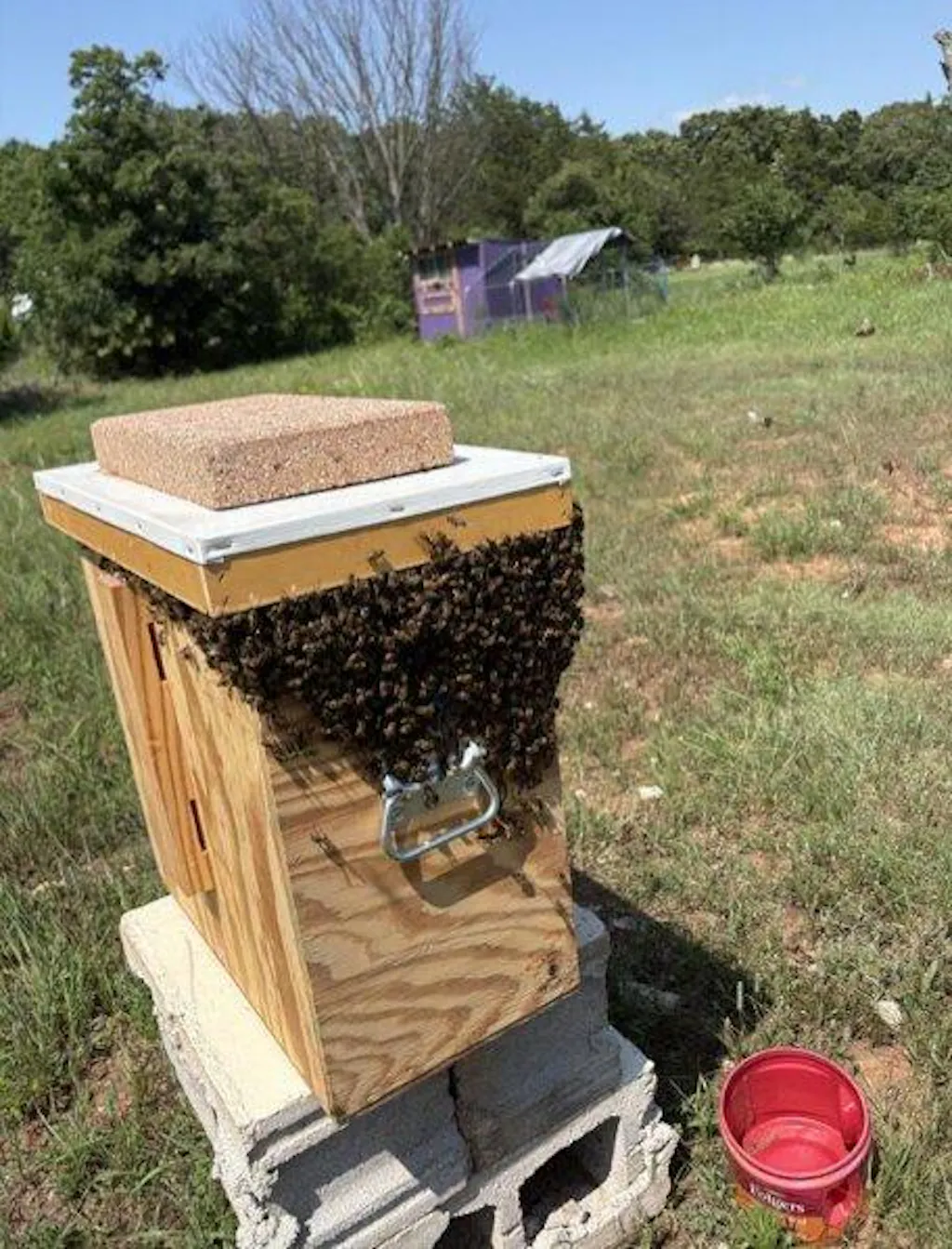
Wax Dipped Swarm Trap with UV Blue Dials
Couldn't load pickup availability

Leaning on science from Dr Tom Seeley and several other studies to inform us as we designed them, our swarm traps ensure your best chances of success at catching swarms and our wax dipping will make them last for many years with no painting.
We start with a box built with quality 5/8" sanded plywood that fits 6 frames with an internal volume of around 49 liters and assemble it with wood glue and staples. The telescoping lid has a 2" pine rim with 1/4" plywood glued and stapled in a rabbet and is covered with aluminum to ensure the trap stays dry and welcoming to scout bees. We attach strapping blocks to both sides to allow for mounting flexibility, and then we wax dip the swarm traps and lids to make them last and continue catching swarms for you season after season for many years to come. We 3D print the entrance dials in house with UV reactive blue PETG filament which emits UV blue that multiple studies have shown to be especially attractive to bees and dramatically increase the success rate of swarm traps. We include a 1.5" entrance hole and dial at each end of the trap, one high and one low, to allow for beekeeper's preference of entrance location and also for cross flow ventilation when closing up and transporting a swarm catch. Heavy duty folding metal handles are included to allow for easy carrying and handling of the trap, one-handed carrying of the trap up a ladder and additional optional strapping points.
- 5/8” sanded plywood construction
- ~49 liter volume
- Two 1.5" entrance holes, one high on one end and one low on the other end, allowing for flexibility of use as well as ventilation during transport
- Entrance dials are uv reactive blue which studies have shown to dramatically increase swarm catches
- Telescoping lid to ensure trap stays dry and welcoming to scout bees
- Heavy duty folding handles on each end allow for easy handling of the trap as well as additional strapping points
- Mounting blocks on each side allow for easy and secure strapping and are thicker than the lid so whatever the trap is strapped to does not interfere with the lid
- Fits up to six deep Langstroth frames
- Lid can double as a 5 frame nuc lid outside of swarm season
- Wax dipped for many years of service